


Views: 0 Author: Site Editor Publish Time: 2026-07-22 Origin: Site


Transitioning from wired pendants to an industrial wireless remote control is not just an operator preference. It is a critical safety and throughput decision. Operators need freedom to navigate complex environments securely and efficiently.
Outdated controls severely limit operator visibility on the plant floor. They expose workers to hazardous loads during intricate lifting procedures. Furthermore, trailing physical cables create constant snagging risks and persistent maintenance bottlenecks.
This guide provides plant managers, safety directors, and procurement teams with an evidence-based framework. You will learn how to evaluate, shortlist, and procure a reliable system safely. We outline exactly how to define success criteria and navigate complex technical specifications.
Safety is measurable: Demand systems with verifiable PL-d/PL-e (Performance Level) or SIL 2/SIL 3 (Safety Integrity Level) certifications.
Form follows function: Choose between handheld push-button systems for simple hoists and joystick belly boxes for multi-axis, complex crane radio remote controls.
Signal integrity is non-negotiable: In environments with high RF noise, Frequency Hopping Spread Spectrum (FHSS) prevents dangerous signal drops.
Defining the core business case requires looking past the basic equipment swap. Untethering the operator reduces walk-time drastically. Operators no longer waste time navigating around physical barriers just to accommodate a pendant cable. They can position themselves dynamically during a lift. This improved vantage point boosts load-spotting accuracy immediately. More importantly, it directly mitigates struck-by hazards. Workers can easily maintain optimal standoff distances from active loads.
To measure the success of your upgrade, you need concrete baselines. A robust wireless crane control implementation should target three primary areas of improvement.
Operational Efficiency: Track the reduction in load spotting time. Observe shifts in operator fatigue levels. Untethered operators experience significantly less physical strain over an eight-hour shift.
Safety Compliance: Measure the ability to achieve strict safe standoff distances. This is absolutely vital for specific hazardous loads. Examples include moving vats of molten metal or navigating open chemical baths.
Downtime Reduction: Document the elimination of pendant cable snags. Track the drop in wire fatigue failures. Physical cables break down under constant twisting, causing unexpected work stoppages.
You must evaluate new equipment against strict technical dimensions. Relying on basic functionality is never enough for overhead lifting operations.
Modern lifting demands foolproof safety architectures. You must evaluate systems for redundant safety relays. These relays must feature forced-guided contacts. If one contact welds shut due to an electrical fault, the mechanical linkage forces the other contacts to remain open. This prevents runaway crane movements. Furthermore, you must require an automatic "Emergency Stop" (E-Stop) functionality. The system must default to a safe, powered-down state instantly upon any signal loss.
Signal reliability separates professional gear from standard consumer electronics. Compare fixed-frequency transmitters against Frequency Hopping Spread Spectrum (FHSS) technology. Fixed frequencies suffer in modern plants. Plant-floor interference from Wi-Fi routers and heavy machinery arc welding disrupts static signals. FHSS bypasses this by rapidly jumping channels. You should also assess programmable range limiting. Pitch-and-catch capabilities allow two operators to safely hand off control of a single crane. Programmable limits prevent operation from unsafe, distant blind spots.
A reliable industrial lifting remote must survive harsh daily realities. Specify minimum IP65 or IP67 ratings. These ratings guarantee resistance against penetrating dust, machine oil, and heavy moisture. You must also verify operating temperature ranges carefully. Electronics degrade rapidly in foundries. Cold-storage applications can easily freeze standard batteries. Ensure your chosen hardware matches your facility's specific climate extremes.
Consider the physical toll on the operator. Analyze shift-length capabilities thoroughly. You need a minimum of 12 hours of continuous use per charge. Mid-shift battery swaps disrupt workflow and invite errors. Evaluate the tactile feedback of the buttons or joysticks. Operators wear thick, heavy safety gloves. They must feel a distinct physical click for every input to prevent accidental movements.
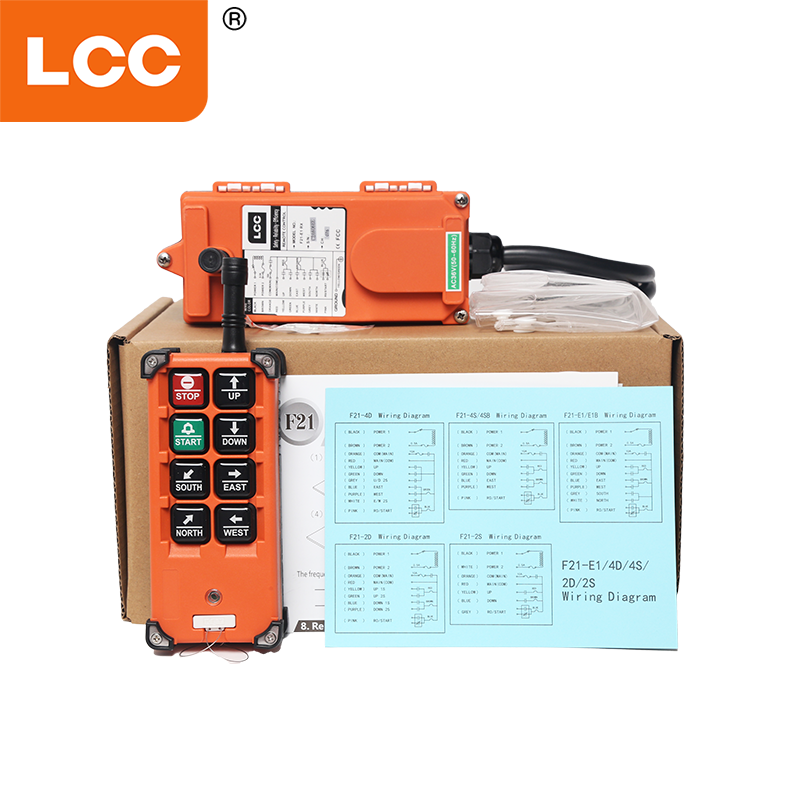
Matching the right transmitter style to the job prevents operational frustration. Over-equipping a simple hoist wastes capital. Under-equipping a complex bridge crane compromises safety.
These units resemble large, ruggedized television remotes. They are best for standard three-motion overhead cranes. They handle bridge, trolley, and hoist movements effectively. They are also ideal for monorails and single-speed or two-speed applications. Their main pros include high portability and lower weight. Operators can clip them to a belt easily. However, they are limited. They do not allow for simultaneous multi-axis control easily.
These larger consoles sit against the operator's waist. They are best for complex bridge cranes and tandem lifts. Variable frequency drive (VFD) controls require the proportional speed adjustments that joysticks provide. They offer superior accuracy and highly custom switch configurations. The primary downside is bulk. They are heavier and require operators to wear dedicated supportive harnesses.
Below is a quick comparison chart to help you visualize the differences:
Feature Category | Handheld Push-Button | Joystick Belly Box |
|---|---|---|
Ideal Application | Standard 3-motion cranes, monorails | Complex multi-axis cranes, tandem lifts |
Speed Control | Single-speed or two-speed steps | Smooth, proportional VFD control |
Portability | High (clip to belt) | Low (requires shoulder/waist harness) |
Simultaneous Motions | Limited (difficult to press multiple buttons) | Excellent (fluid dual-joystick manipulation) |
Procuring the hardware is only the first phase. Integrating an overhead crane remote control involves navigating distinct physical and human variables.
Address the reality of integrating modern wireless receivers with older machinery. Older contactor-based crane panels require careful relay mapping. You must ensure the new receiver interfaces safely with legacy wiring. Identify early if a full VFD upgrade is necessary. Sometimes, adding a highly proportional remote to a binary contactor panel yields no real benefit without upgrading the drive itself.
Deploying multiple systems on the same floor creates massive crosstalk risks. Unplanned interference can cause unexpected crane movements. You must implement strict solutions. Conduct pre-deployment RF site surveys to map existing frequency usage. Enforce strict MAC address pairing protocols. This mathematically locks one specific transmitter to one specific receiver, rejecting all outside noise.
Moving from a physical pendant to spatial remote operation introduces a steep learning curve. Operators lose the physical cable that once acted as a spatial reference line. They must relearn how to orient themselves relative to the bridge and trolley. You must implement rigorous training.
Highlight the necessity of updated daily inspection checklists. A proper wireless daily checklist should include:
Inspecting the transmitter casing for stress fractures or seal degradation.
Testing the E-Stop button for immediate mechanical responsiveness.
Verifying battery charge levels before the shift begins.
Confirming the receiver's status LED indicates a secure pairing.
Testing all motion buttons for distinct tactile feedback.
Choosing the right manufacturing partner determines your long-term success. You must vet vendors thoroughly to ensure lasting reliability.
First, verify all safety certifications strictly. Do not accept generic "CE" or "FCC" claims as proof of operational safety. Demand official documentation for ISO 13849-1. This specific standard governs the safety of machinery and control systems. You also need guaranteed local OHSA and ASME compliance.
Second, assess their supply chain and spare parts availability. You must know the exact lead times for replacement transmitters, batteries, and receiver relays. A broken remote should never ground a vital crane for weeks. Reliable vendors maintain robust local inventories of critical components.
Third, prioritize vendors who offer comprehensive warranty and integration support. Look for partners providing onsite commissioning support. Ensure they offer OEM warranties of at least one to two years. Accessible technical troubleshooting is mandatory. You need a hotline to engineers who understand crane circuitry deeply.
Your next step is drafting a highly specific operational requirement list. Count the exact number of crane motions needed. Document your specific environment type, including dust and heat levels. Define your desired safe operating range. Complete this mapping before reaching out to source a high-quality industrial wireless remote control system. This preparation ensures you evaluate an Industrial Remote Control based on your actual operational reality.
Choosing an overhead crane remote control represents a major investment in human safety and mechanical longevity. It is far more than a tactical equipment purchase. Untethering your operators reduces fatigue, improves sightlines, and strictly enforces safe standoff distances.
You must rigorously match the remote's complexity to your specific lifting task. A basic push-button unit handles simple hoists beautifully. However, complex multi-axis lifts require the precision of a proportional joystick belly box. Always prioritize systems featuring FHSS technology and verifiable safety relays.
Take action today by consulting with a certified crane systems integrator. Have them map your facility's RF environment thoroughly. Review compliant, certified remote solutions that align with your daily operational demands.
A: Yes. Modern systems use dedicated receiver units that wire directly into the crane’s existing control panel. While most cranes accept these receivers seamlessly, much older contactor-based cranes might require minor relay panel upgrades to ensure safe signal integration.
A: The system relies on a strict fail-safe mechanism. If the receiver detects any signal loss or power failure, it automatically triggers an E-Stop protocol. This halts all crane movement immediately, ensuring the load remains completely static and safe until connection is restored.
A: The typical operational range spans 300 to 500 feet. However, the exact safe distance depends entirely on your plant layout and specific load hazards. Many modern systems allow administrators to program configurable safety perimeters directly into the device.