


Views: 0 Author: Site Editor Publish Time: 2026-11-22 Origin: Site


Specifying a remote control system demands precision. You must balance operational capability against operator cognitive load. Over-specifying buttons introduces unnecessary costs, complicates wiring, and increases potential operator errors. Conversely, under-specifying severely limits equipment utility. Missing functions inevitably invite dangerous operational workarounds.
The ideal button count is never arbitrary. It serves as a direct mathematical reflection of your machine's hydraulic directional control valves (DCVs). Your layout must perfectly accommodate required auxiliary functions and non-negotiable safety interlocks. Finding the right hardware configuration prevents long-term operational headaches.
This guide provides equipment buyers, fleet managers, and systems engineers a clear technical framework. We will help you evaluate remote control configurations methodically. You will learn to map functions for everything from basic single-axis tools to complex multi-functional radio systems. By following these mathematical guidelines, you ensure every button serves a distinct, necessary purpose.
The 1:2 Baseline Ratio: Every standard double-acting hydraulic function (e.g., boom up/down, winch in/out) requires a minimum of two buttons.
Auxiliary Demands: Total button count must account for non-hydraulic functions such as engine start/stop, RPM increase/decrease, and horn/alarms.
Speed Control Dictates Hardware: The choice between a basic on/off system and proportional control drastically alters the remote’s internal architecture and receiver complexity.
Safety is Exempt from the Count: Emergency Stop (E-Stop) and active-enable switches are mandatory safety requirements and should never be counted as "functional" buttons in your available layout.
Engineers and purchasers must establish clear baseline technical requirements early. The foundation of any well-designed Hydraulic Remote Control system relies on basic arithmetic. You map electrical inputs directly to hydraulic outputs. Each movement requires a dedicated signal path.
Let us start by analyzing double-acting versus single-acting cylinders. A standard double-acting cylinder powers movement in two directions. Pushing fluid into one port extends the rod. Pushing fluid into the opposite port retracts it. This translates to a simple standard mapping rule. One spool valve equals two distinct machine motions. Therefore, one spool valve requires two separate buttons.
Single-acting cylinders operate differently. They use fluid pressure for extension but rely on gravity or spring tension for retraction. Technically, a gravity-return cylinder may only require one active button to open the pressure valve. However, manufacturers usually retain a standard two-button layout on the transmitter. One button energizes the pump and opens the supply valve. The second button simply opens a dump valve back to the reservoir. Keeping the two-button format standardizes receiver wiring. It also preserves predictable muscle memory for operators handling multiple implements.
Next, we apply the "Plus Two" rule for auxiliary functions. Machine operators rarely just move cylinders. They must manage the prime mover driving the hydraulic pump. You must budget buttons for non-hydraulic actions. Power Take-Off (PTO) engagement requires dedicated inputs. Scene lighting on night jobs needs independent control. Engine throttle management is arguably the most critical auxiliary function.
Consider a common decision lens. You specify a basic remote covering only the boom and winch. The operator deploys the boom and realizes the engine RPM is too low to lift the heavy load. Without throttle control on the remote, they must walk back to the cab. They adjust the idle manually, then walk back to the load. Failing to account for throttle management completely negates the efficiency gained by using a wireless system. Always audit required auxiliary functions before finalizing your layout.
Buyers must match standard industry configurations to their specific fleet needs. No single layout fits every piece of heavy machinery. Analyzing common equipment types reveals how button counts scale alongside mechanical complexity.
Basic implement control typically requires two to six buttons. You see these setups on simple dump trailers, hydraulic lift gates, or basic single-spool log splitters. These applications pair almost exclusively with straightforward on/off valves. A two-button remote handles basic up/down motions. A four-button unit might add a power latch or an auxiliary light toggle. Six buttons provide enough flexibility for a dual-cylinder trailer featuring independent leveling jacks.
Heavy recovery and towing operations demand significantly more capability. A modern wrecker or rotator often utilizes an eight to twelve-button configuration. Integrating a 12-Button Hydraulic Winch Remote Control provides comprehensive scene management. Let us break down a typical mapping for a heavy wrecker. You need two buttons for the main winch. Two more operate the auxiliary winch. Boom elevation requires an up and down pair. Boom extension takes another two. Wheel lift deployment adds two more. Finally, you reserve two buttons for engine start/stop and RPM management. This exact mapping consumes all twelve buttons quickly.
Material handling and articulated equipment push these requirements even further. Forestry forwarders, knuckle-boom loaders, and construction cranes routinely require ten or more buttons. The complexity lies in multi-axis simultaneous movements. Operators must slew the turret, luff the boom, and hoist the load simultaneously. This necessitates a robust Multi-Button Crane Radio Remote Control.
Implementation realities dictate strict design rules here. Crane operators often require custom button grouping. Engineers utilize sequenced layouts to separate opposing functions physically. Placing a "boom down" button too close to a "fast winch release" creates immense danger. Operators wearing gloves might accidentally hit the wrong adjacent button. This causes catastrophic load shifts. Proper spacing and logical button grouping prevent these fatal errors.
Equipment Type | Typical Button Range | Common Mapped Functions |
|---|---|---|
Dump Trailers / Lift Gates | 2 to 4 Buttons | Gate Up/Down, Deck Tilt, Latch Release |
Skid Steer Attachments | 4 to 6 Buttons | Tilt, Grapple Open/Close, Aux Flow Toggle |
Heavy Recovery Towing | 8 to 12 Buttons | Main Winch, Aux Winch, Boom Elevate, Wheel Lift, RPM |
Knuckle-Boom Cranes | 10 to 14+ Buttons | Slew Left/Right, Main Boom, Stick Boom, Hoist, Engine Control |
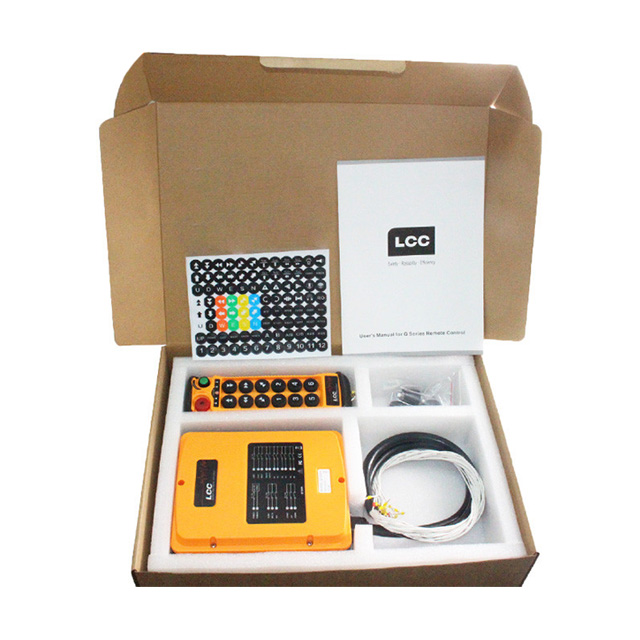
Decision-makers evaluating price-to-performance ratios must deeply understand valve compatibility. Your underlying hydraulic manifold ultimately dictates your transmitter hardware. You cannot force a basic remote to perform complex proportional tasks.
We first examine the case for bang-bang controls. A Single-Speed Industrial Remote Control relies entirely on simple open/close relay logic. When you press the button, the valve opens 100%. When you release the button, the valve closes completely. There is no middle ground.
This single-speed approach offers immense benefits. These systems are highly reliable in harsh conditions. They prove exponentially easier to troubleshoot in the field. A mechanic only needs a multimeter to check if a relay clicks and sends 12 volts to the coil. Furthermore, single-speed systems boast a significantly lower procurement cost. They remain ideal for simple winching applications, standard outrigger deployment, or agricultural implements.
Conversely, the case for proportional controls centers on precision. Proportional systems allow operators to feather the load. Barely pressing the control barely opens the valve. This smooth operation requires specialized hardware. The receiver must generate PWM (Pulse Width Modulation) outputs. These distinct electrical pulses tell the proportional valves exactly how far to open.
Because PWM requires varied inputs, basic buttons no longer suffice. Standard buttons are often replaced or augmented by variable-pressure triggers. Some remotes utilize multi-step detent buttons. A half-press sends a slow-speed signal. A full-press sends a high-speed signal. Advanced setups use small paddles or mini-joysticks integrated into a handheld frame.
We must conduct a strict risk assessment regarding retrofits. Retrofitting proportional control onto a legacy single-speed hydraulic block rarely makes financial sense. The remote control transmitter cannot magically create variable fluid flow. If your existing directional control valve is strictly on/off, it only understands 0% or 100%. Upgrading the remote requires an expensive, complete valve bank replacement. Always audit your existing manifold before upgrading your transmitter.
Feature / Requirement | Single-Speed (Bang-Bang) | Proportional (PWM) |
|---|---|---|
Valve Operation | 100% Open or 100% Closed | Variable opening based on input |
Typical Input Method | Standard momentary buttons | Paddles, triggers, or dual-detent buttons |
Electrical Output | Standard 12V/24V Relays | Pulse Width Modulation (PWM) |
Best Application | Outriggers, dump beds, basic winches | Crane hoisting, delicate material handling |
Safety officers and operational managers hold the responsibility of mitigating liability. Remote control systems introduce distance between the operator and the hazard. However, this distance requires strict technological safeguards.
Mandatory ISO/EN safety compliance drives modern remote architecture. Under ISO 13849-1 standards, every industrial wireless controller must feature a dedicated safety circuit. Every hydraulic remote control must incorporate a hard-wired, functionally distinct Emergency Stop mechanism. This E-Stop typically carries a PL-d or PL-e safety rating. When an operator hits the E-Stop, the receiver drops the main power relay instantly. It cuts all electrical flow to the hydraulic solenoids. This overrides any stuck buttons or radio interference. Remember, the E-Stop does not count toward your functional button limit. It exists entirely outside the standard operational mapping.
Cognitive load and button spacing directly impact workplace safety. Packing too many functions onto a small handset creates a dangerous operational environment. More buttons require smaller profiles. Engineers must utilize tighter spacing to fit everything onto a handheld circuit board. This creates severe hazards for operators wearing heavy industrial gloves. A gloved thumb can easily bridge two closely spaced buttons. Pressing "winch release" and "boom down" simultaneously causes catastrophic accidents.
Industry experts provide a clear recommendation. If an application requires more than twelve discrete functions, you should abandon handheld layouts. A belly-box transmitter provides a statistically safer platform. Belly boxes utilize sturdy toggle switches and multi-axis joysticks. They offer ample physical separation between controls. This drastically improves ergonomics and reduces operator fatigue during long shifts.
We must also evaluate feedback mechanisms. A well-designed remote tells the operator what it is doing. Does the remote provide tactile feedback? High-quality buttons feature distinct detents. The operator feels a definitive click when the contact closes. Does the unit offer visual feedback? Many modern transmitters utilize bright LED arrays or small LCD screens. These displays confirm function actuation. They also display critical telemetry like low transmitter battery levels or poor radio signal strength. Good feedback mechanisms prevent operators from second-guessing their equipment.
Final-stage buyers preparing to request a quote must avoid common pitfalls. Fixing a specification error after the hardware ships wastes time and consumes maintenance budgets. Follow a strict evaluation criteria checklist before placing an order.
First, verify your receiver output capacity. Transmitter buttons mean nothing if the receiver lacks corresponding relays. Ensure the receiver unit has enough discrete channel outputs. A twelve-button remote requires a receiver equipped with at least twelve independent relays. You also need an additional master relay for the safety dump valve. Never assume a twelve-button transmitter automatically pairs with a twelve-relay receiver. Always verify the receiver's internal wiring schematic.
Receiver Channel Count: Audit the exact number of active relays inside the receiver box.
Relay Amperage: Ensure the internal relays can handle the current draw of your hydraulic solenoids without burning out.
Operating Range: Verify the transmitter's broadcasting range matches your typical job site distances.
Next, focus on future-proofing your investment through blank buttons. Operational requirements change over time. Fleet managers often bolt new attachments onto existing equipment.
Consider this implementation strategy. Always specify a transmitter featuring two extra buttons wired as blanks. You map your current ten functions perfectly. You leave buttons eleven and twelve disconnected at the receiver. Six months later, you add a hydraulic tool circuit to the machine. Because you planned ahead, you simply wire the new valve to the existing blank relays. This allows for the immediate addition of auxiliary hydraulic lines. You avoid the massive expense of replacing the entire remote control system.
Finally, scrutinize the hardware's environmental ratings. Heavy equipment lives outdoors. Your electronics must survive rain, mud, and chemical exposure. Verify IP65 or IP67 ratings for both the transmitter and receiver.
An IP65 rating protects against low-pressure water jets. An IP67 rating ensures survival during temporary total submersion. Pay special attention to the button membrane. Assess its resistance to hydraulic fluid degradation. Spilled hydraulic oil rapidly degrades cheap rubber. You must also verify UV exposure ratings. Sunlight turns poor-quality plastics brittle within months. Specifying industrial-grade polymers ensures your remote survives harsh daily abuse.
Conclusion
Selecting the correct number of buttons is a direct translation of your hydraulic schematic. A baseline 1:2 ratio dictates the core count for every double-acting cylinder. Speed requirements determine whether you need standard buttons or proportional triggers. Auxiliary controls and operator ergonomics refine the final physical layout.
Before purchasing new hardware, audit the target machine’s valve bank to confirm on/off or proportional compatibility. Document every necessary operator action required outside the cab. Pay special attention to engine throttle and lighting. Finally, consult with a hydraulic controls specialist to map your exact schematic. They will help you match your specific needs to the appropriate transmitter-receiver pairing. Taking these steps guarantees a safe, efficient, and reliable wireless workflow.
A: No. Each discrete directional movement requires a dedicated output. A four-function block handles eight distinct actions (e.g., four extensions, four retractions). You would either need to abandon a hydraulic function entirely or upgrade to an eight-button minimum remote to maintain full mechanical capability.
A: Yes. Diverter valves allow one spool to control two different cylinders. Your remote will need a dedicated button to toggle the diverter valve's electrical coil. Operators usually hold this "shift" button while pressing standard directional buttons to actuate the secondary hydraulic circuit.
A: Upgrade when the operator needs to perform simultaneous, multi-axis proportional movements. Booming up while slewing and winching requires precise feathering across multiple valves. Handheld button remotes serve sequential, single-axis operations best. Belly-boxes drastically improve safety and ergonomics for complex crane and forestry work.
A: Not if properly configured during installation. Unused buttons should remain electronically disabled at the receiver level. Technicians simply leave the corresponding receiver relays unwired. This completely prevents accidental actuation if an operator inadvertently presses a blank button while working.