


Views: 0 Author: Site Editor Publish Time: 2026-05-29 Origin: Site


A tower crane remote control is an industrial wireless control system used to help trained operators control cranes, hoists, winches, gantry cranes, and other lifting equipment from a safer and more flexible position. For Nanjing Xiading Electronic Technology Co., Ltd., the LCC product range focuses on industrial remote control systems for demanding job sites, lifting equipment, and construction machinery.
The article topic should be repositioned around professional lifting safety, equipment matching, and product selection. A more suitable title is Industrial Crane Remote Controls for Safe Lifting Operations. This angle matches LCC’s real product scope and gives readers useful guidance on how industrial crane remote controls support safer, more efficient daily operation.
Industrial crane remote controls are designed for actual lifting equipment. They are used in environments where loads, movement direction, electrical signals, receiver response, and operator position all matter. An industrial crane remote control must work with real machines, electrical control cabinets, and job-site safety procedures.
In lifting applications, the operator may need to stand away from a suspended load, avoid blind areas, and maintain a clear view of hooks, spreaders, lifting points, or moving equipment. A wireless remote control can help reduce the need to operate only from a fixed pendant station or cab position. However, it must always be used by trained personnel according to local safety rules, crane manufacturer instructions, and site operating procedures.
That is why the article should explain how different LCC industrial remote controls can fit different lifting tasks, such as single-speed crane movement, double-speed hoist control, truck-mounted crane operation, and multi-button winching or forestry equipment control.
A crane remote control system usually includes a transmitter, a receiver, buttons or joystick controls, internal or external antennas, electrical output connections, and safety-related operating logic. The transmitter sends commands wirelessly. The receiver connects to the equipment control circuit and converts the wireless signal into machine movement commands.
For operators, the main benefit is better positioning. Instead of standing beside a fixed control station, the operator can choose a safer viewpoint where the load, landing area, and surrounding workers are easier to observe. For overhead and gantry crane applications, overhead crane remote control systems can support safer communication between the operator and the lifting area when used with proper procedures.
Even so, the remote control itself does not replace training, inspection, load planning, or safe rigging. Before each lift, the operator should check the transmitter, emergency stop function, receiver status, battery condition, button labels, and movement direction. The work area should be clear, and the operator should never stand under a suspended load.
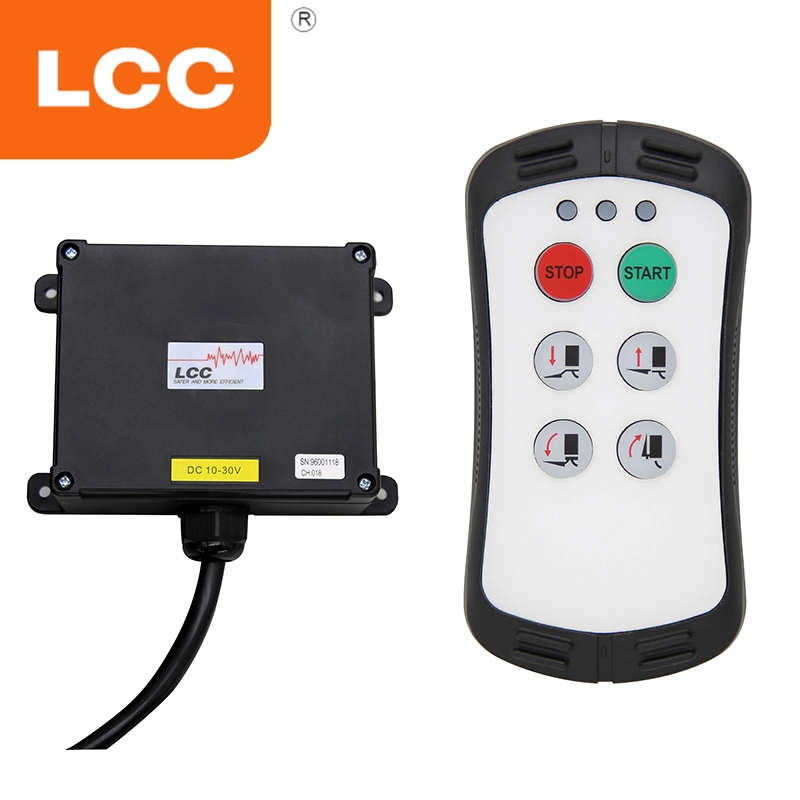
Different lifting applications need different control layouts. A small hoist may need fewer buttons, while larger handling equipment may need more channels, double-speed control, or joystick control. The following LCC models are suitable for industrial content because they connect directly to real lifting and machinery control needs.
LCC Model | Typical Control Type | Suitable Application Direction |
|---|---|---|
A400 4 channels single speed industrial radio remote control | 4-channel single-speed control | Simple crane, winch, and lifting equipment control where a compact transmitter layout is preferred. |
4 single-speed buttons | Gantry crane and crane movement control that requires a simple, clear button layout. | |
6 double-speed buttons | Hoist crane applications where low-speed positioning and faster travel may both be needed. | |
8 single-speed buttons | Winching, forestry, and lifting operations that need more command channels. | |
Joystick control | Truck-mounted crane and construction machinery applications where proportional-style hand control may be preferred. |
The A400 is a practical option when a lifting task needs a straightforward four-channel single-speed wireless control layout. A compact transmitter can be helpful for operators who need clear basic commands without too many unused buttons. For many lifting and winching applications, simple controls can reduce confusion and support a cleaner operating process.
The A400 product page lists the model as A400 and shows industrial remote control positioning, CE and FCC certification, an IP65 protection class, and a 100-meter distance specification. These features make it suitable for real industrial use and product-based content. When the application only needs a limited number of movement commands, A400 can be considered as part of a basic wireless control configuration.
The Q400 is positioned as a 4-channel single-speed industrial radio remote control for gantry crane applications. Its four single-speed buttons can support clear directional operation when the machine configuration is simple. This makes it useful for customers who want a direct handheld transmitter for basic crane movements.
For industrial buyers, the key point is not entertainment value. The important factors are button function, signal stability, receiver compatibility, environmental protection, and installation requirements. The Q400 page lists UHF 420–450 MHz frequency, IP65 protection, reinforced nylon plastic housing, and multiple voltage options. These details help show why Q400 belongs in an industrial crane remote control article.
Some lifting tasks require more than basic on/off movement. For example, an operator may want slower motion when placing a load near a target point and faster motion during longer travel. In such cases, a double-speed remote control can be more suitable.
The Q606 is listed as a 6-button double-speed wireless transmitter and receiver for hoist crane remote control. This makes it useful for hoist applications where operators need better movement control during lifting, lowering, and positioning. Its product page also lists UHF 420–450 MHz frequency, IP65 protection, reinforced nylon plastic housing, and distance information. These features make the Q606 a relevant internal product link for articles about safe crane operation and hoist control.
When equipment requires more control commands, an 8-button transmitter may be more appropriate. The Q800 is presented as an 8-button RF remote controller for winching and forestry applications. It can be used in content that discusses more complex equipment control where additional command channels are needed.
The Q800 page lists single-speed 8-button control, UHF 420–450 MHz frequency, IP65 protection, reinforced nylon plastic housing, and multiple voltage options. In an optimized article, the Q800 should be introduced as an industrial RF remote control option for practical job-site equipment. This helps align the article with the customer’s actual product and service range.
Not every lifting application uses only push-button control. Truck-mounted cranes and certain construction machinery may benefit from joystick-style operation. The BT400 page describes a manual automatic integration joystick truck mounted crane wireless remote control, with 4-joystick, 5-joystick, and 6-joystick types available.
For content optimization, BT400 is useful because it expands the article beyond simple button transmitters. It shows that LCC can support more specialized control habits and machine operation needs. A joystick remote control may help operators handle multiple movement axes in a more natural way, depending on equipment design and site requirements.
Choosing the right crane remote control should begin with the machine, not the transmitter appearance. The number of motions, speed requirements, receiver voltage, working distance, duty environment, and operator habits should all be reviewed before selecting a model.
Control channels: Match the number of buttons or joysticks to the equipment’s real movement commands.
Speed type: Choose single-speed or double-speed control according to positioning needs.
Receiver compatibility: Confirm voltage range, wiring logic, and output requirements before installation.
Working environment: Consider dust, moisture, temperature, and impact risk.
Operator workflow: Select a button or joystick layout that supports safe, clear, and repeatable operation.
For projects with uncertain requirements, customers can review LCC’s industrial remote control range and contact LCC remote control specialists for product matching support.
A well-selected remote control is only one part of safe lifting. Operators should complete routine checks before use and follow strict site rules during lifting. The transmitter should be inspected for damaged buttons, unclear labels, low battery power, or broken housing. The receiver and machine response should also be tested before any load is lifted.
During operation, the user should keep a clear line of sight to the load whenever possible, stay away from suspended loads, and stop operation if communication is unclear. The emergency stop should be accessible, and unauthorized personnel should not use the transmitter. When work ends, the transmitter should be powered off and stored properly to prevent unintended operation.
A suitable title is Industrial Crane Remote Controls for Safe Lifting Operations. It matches LCC’s actual product scope and industrial application scenarios.
The A400 and Q400 can both be used as relevant options for four-channel or four-button single-speed industrial control applications, depending on the equipment and installation requirements.
A double-speed remote control such as Q606 may be considered when the operator needs both slower positioning movement and faster travel movement for hoist crane operation.
A joystick remote control may be useful for truck-mounted cranes and machinery that require multi-axis control. The BT400 product direction is suitable for this type of application.
No. The correct model depends on the crane type, number of commands, speed requirements, voltage, receiver connection, working distance, and site environment.
This revised article direction matches Nanjing Xiading Electronic Technology Co., Ltd. and the LCC product range. LCC supplies industrial remote control systems, so the article should focus on safe lifting operation, crane control requirements, product selection, and real industrial models.
By changing the title to Industrial Crane Remote Controls for Safe Lifting Operations and building the content around A400, Q400, Q606, Q800, and BT400 product links, the article becomes more accurate, more useful, and more suitable for the customer’s website. This revised direction also improves internal linking because each anchor text now connects naturally to a real LCC product or service page.