


Views: 0 Author: Site Editor Publish Time: 2026-08-13 Origin: Site


Upgrading to a proportional joystick remote directly impacts load positioning accuracy, operator safety, and cycle times. Moving heavy materials requires more than basic directional commands; it demands absolute fluidity in the air. Unlike basic push-button pendants, proportional controllers require careful alignment with your crane’s hydraulics, electrical infrastructure, and operational environment. A mismatched system causes jerky movements, risking severe accidents and dangerous load sway. We understand how overwhelming hardware selection feels when facing complex technical specifications. This guide provides a technical evaluation framework for selecting the right system without overspending on unnecessary features. You will discover exactly how to match signal outputs, verify critical safety ratings, and choose optimal transmitter technology for your lifts.
Precision dictates hardware: Match the joystick’s output (voltage, PWM, or CAN-bus) exactly with your crane’s proportional directional control valves.
Environment drives frequency: Select a wireless transmitter receiver with Frequency Hopping Spread Spectrum (FHSS) to bypass heavy industrial RF interference.
Durability requires specifics: Mandate Hall-effect sensors over mechanical potentiometers to prevent dead zones and physical wear in the industrial joystick controller.
Compliance is non-negotiable: Verify ISO 13849-1 (PL) or IEC 62061 (SIL) certifications for the Emergency Stop (E-Stop) circuitry.
You must begin by analyzing your specific machine class. Different lifting machines demand entirely different interface priorities. For instance, a tower crane joystick remote operates outdoors exclusively. This setup requires extreme signal range and aggressive weatherproofing against rain, salt spray, and UV degradation. Overhead or bridge cranes operate indoors. They face an entirely different set of challenges. Factory floors create heavy radio frequency interference. Steel girders bounce signals randomly. You also frequently need multi-hoist synchronization capabilities for tandem indoor lifts.
Every industry moves loads differently. Define your specific need for micro-speed adjustments. Fragile assembly placement requires fractional inch movements to avoid crushing components. Pouring concrete demands steady, predictable fluid control to prevent splashing. Blind lifts present the ultimate challenge. The operator relies entirely on a spotter. They need a system that translates minute hand twitches into incredibly slow, deliberate hoist movements. True proportional signaling makes these micro-adjustments possible.
Map out where your operators must stand during a typical shift. They need an optimal line-of-sight for every lift. Restricting their movement reduces safety margins. Ergonomics play a massive role here. A "belly box" style remote distributes weight across the shoulders and hips. This design prevents severe lower back and neck fatigue during ten-hour shifts. Consider the physical burden your team carries daily.
Audit your physical workspace for signal blind spots.
Shadow your operators to map out their daily walking paths.
Document specific weather exposure levels for all outdoor equipment.
Measure the heaviest and most delicate loads handled weekly.
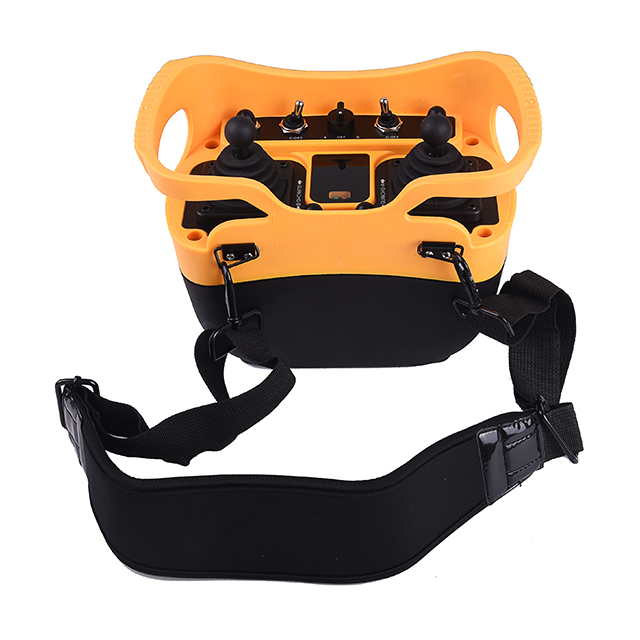
Basic stepped controllers rely on distinct speed gears. You press a button for speed one, speed two, or speed three. This creates harsh transitions. True proportional crane control allows step-less, infinite variable speeds based strictly on the joystick deflection angle. Pushing the stick slightly creeps the hoist. Pushing it further accelerates the load smoothly. This fluidity eliminates pendulum load sway. It also prevents violent hydraulic shocks. Hydraulic shock damages expensive seals and cylinder walls over time.
The internal sensors define long-term precision. Traditional potentiometers use mechanical wipers sliding across carbon tracks. They wear down physically. Dust ingress ruins their accuracy. They eventually develop dangerous "dead zones" where joystick movement produces no output. Hall-effect sensors offer a modern alternative. They use magnetic fields to detect position changes. They feature zero mechanical contact points. This contactless design makes them highly durable and immune to dust or moisture.
Feature | Hall-Effect Sensors | Mechanical Potentiometers |
|---|---|---|
Operation Method | Contactless magnetic fields | Physical sliding wipers |
Durability | Extremely high (millions of cycles) | Moderate (prone to friction wear) |
Dead Zones | Rarely occur | Develop over time |
Environmental Resistance | Excellent (immune to dust) | Poor (vulnerable to dirt ingress) |
You cannot buy a remote solely on its physical design. The controller must output the specific electrical signal your machine requires. You must match the transmitter perfectly to your PLC or hydraulic valves. Typical industrial signals include analog voltage (0-10V), current loops (4-20mA), digital CANopen protocols, or direct PWM (Pulse Width Modulation). A properly configured Proportional joystick remote control crane setup relies entirely on this signal handshake. Supplying 0-10V to a valve expecting PWM results in total system failure.
Establish strict baseline range requirements before purchasing. Assess whether your facility needs 100 meters of coverage or pushes beyond 300 meters for outdoor yards. Range specifications mean nothing without low latency. Latency represents the delay between moving your hand and the crane responding. Acceptable latency thresholds sit below 50 milliseconds. Sub-50 millisecond response times feel instantaneous. High latency causes operators to over-correct movements, creating dangerous pendulum swings.
Modern industrial zones overflow with invisible noise. Factory floors house dozens of Wi-Fi routers. Heavy machinery generates electromagnetic fields. Dense steel structures bounce radio waves unpredictably. You need Frequency Hopping Spread Spectrum (FHSS) technology. FHSS jumps across dozens of radio channels multiple times per second. If it encounters a blocked channel, it simply hops to a clear one. This dynamic shifting guarantees uninterrupted communication.
Transmitters face brutal conditions. Forklifts crush them. They fall from high catwalks. When a transmitter breaks, downtime costs escalate rapidly. Assess the ease of replacing a broken unit. Modern systems use electronic keys or RFID smart cards. You simply plug the old card into a new belly box. It instantly syncs. You never need to climb up and reprogram the crane-mounted wireless transmitter receiver manually. This plug-and-play redundancy saves hours of maintenance labor.
Ignoring existing factory Wi-Fi bands during frequency selection.
Buying a system without an automatic channel-hopping feature.
Failing to keep a pre-paired backup transmitter on the floor.
You must perform a deep audit of your existing valves. Many older machines use standard on/off spools. These basic valves simply open fully or close tightly. They cannot modulate fluid flow. Upgrading requires specific electro-hydraulic hardware. You need compatible proportional monoblock or sectional valves. Sectional valves allow you to stack multiple control slices together. They offer great modularity for complex lifting setups.
Retrofitting an older, purely mechanical crane requires patience and the right parts. You cannot attach a digital receiver directly to manual levers. You must install electro-hydraulic interface modules. These conversion manifolds accept digital signals and translate them into hydraulic pilot pressure. This pilot pressure shifts the main directional spools. Budget accordingly for these hydraulic conversion blocks. They often cost as much as the electronics.
Never compromise on physical enclosures. The receiver unit lives on the crane bridge. It faces grease, extreme heat, and severe vibration. Mandate IP65 or IP66 environmental ratings. These ratings guarantee protection against high-pressure water jets and microscopic dust. Demand standardized wiring harnesses. Pre-wired, color-coded harnesses eliminate guesswork. They speed up integration safely. Using CAN-bus technology simplifies this further, reducing thick wire bundles down to just four essential cables.
Industry safety standards serve as your ultimate protection against liability and accidents. Never trust unverified claims. Look for independently certified safety ratings. The Emergency Stop (E-stop) function represents your critical lifeline. It must meet PL-d or PL-e classifications under ISO 13849-1. Alternatively, verify SIL 3 compliance under IEC 62061. These frameworks mandate dual-relay cross-monitoring. If one safety relay fails, the backup relay instantly cuts power.
Passive safety relies on the operator. Active safety intervenes automatically. Demand "dead-man" switches. These require continuous, deliberate pressure to operate. If the operator faints, the machine stops immediately. Tilt and drop sensors provide crucial protection. If the operator trips and drops the controller, the internal accelerometer detects the fall. It automatically cuts power before the remote hits the ground. Out-of-range auto-shutdowns prevent "runaway" loads when the signal degrades.
Flimsy plastic housings shatter in steel mills. Specify fiberglass-reinforced enclosures. They absorb heavy impacts without cracking. The industrial joystick controller must survive harsh daily abuse. Pay attention to tactile feedback. Operators wear thick leather safety gloves. They must feel positive "clicks" and resistance when moving the sticks. If the controls feel mushy, operators lose their spatial awareness.
Battery chemistry dictates your daily operational tempo. Older NiMH batteries suffer from memory effects. They degrade quickly if charged improperly. Lithium-ion batteries deliver superior performance. They hold their charge longer and weigh less. Look for hot-swappable battery designs. Operators can swap a dead pack in seconds without powering down the crane. Target continuous operation times exceeding 20 hours per charge. This guarantees uninterrupted coverage across double shifts.
Choosing the correct interface goes far beyond comparing price tags. The right choice flawlessly balances precision valve compatibility with rugged environmental survival. A proportional system fundamentally changes how your team moves heavy materials, provided it integrates cleanly with your machine's unique architecture. Begin your selection process methodically.
Always start by auditing the crane's current hydraulic valves and PLC logic before ever looking at transmitter brands. Understand your factory's radio frequency landscape. Prioritize independent safety certifications over flashy marketing claims. Take these crucial next steps to finalize your upgrade:
Consult with a qualified systems integrator to verify signal output matching.
Request detailed technical spec sheets to confirm latency figures remain under 50 milliseconds.
Evaluate CAD drawings to plan secure, vibration-isolated receiver mounting locations.
Test the physical ergonomic weight of the belly box to prevent operator fatigue.
A: No. You must install electro-hydraulic proportional valves or a conversion manifold to utilize proportional signals. Standard on/off spools only open or close entirely. They cannot modulate fluid flow for variable speeds.
A: Quality industrial systems operate with near-zero perceptible lag, typically between 15 to 40 milliseconds. This ensures the load reacts instantly to your hand movements. High latency causes over-correction and dangerous pendulum effects.
A: Utilize systems with automatic frequency management and unique ID codes (over 16-bit addressing) to ensure transmitters only talk to their paired receivers. Frequency Hopping Spread Spectrum (FHSS) technology actively dodges crowded channels.